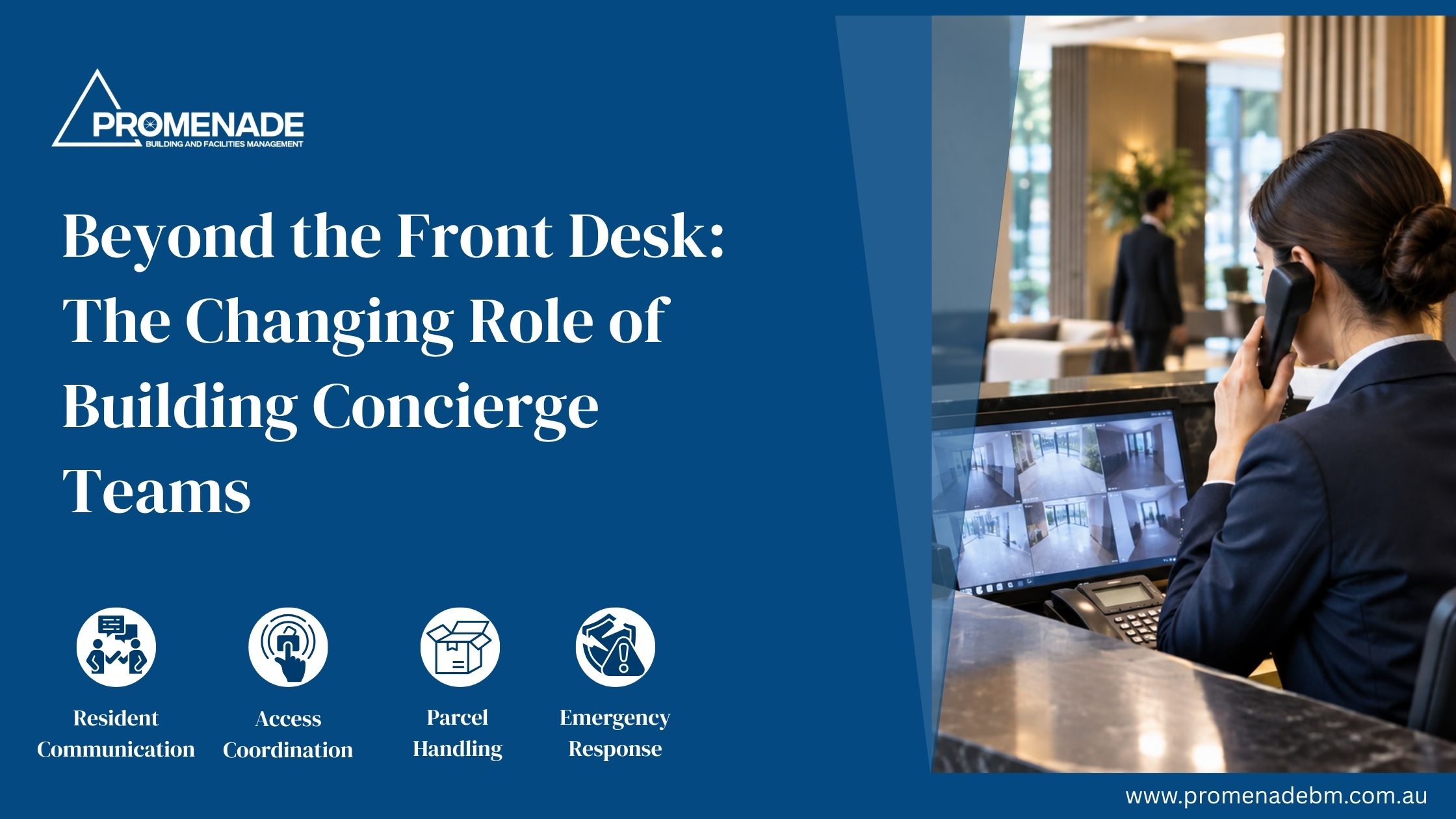
Quick answer: Building concierge teams in Sydney have evolved well beyond greeting visitors and answering phones. Modern concierge services in Sydney now support tenant experience, visitor management, deliveries, contractor coordination, and communication between occupants and building management, working alongside technology to deliver a more consistent and professional building experience.
For decades, the image of a building concierge was fairly simple: a friendly face behind a desk, ready to greet visitors, answer basic questions, and point people in the right direction. That role still exists, but it no longer tells the whole story.
Today’s commercial and residential buildings expect more from their front-of-house teams. Tenants want faster communication. Visitors expect a smooth, professional experience from the moment they walk in. Building owners want consistency, accountability, and a team that can represent the property well. As a result, concierge services in Sydney have grown into a much broader function, one that touches almost every part of how a building operates day to day.
This shift matters for property owners, facility managers, and strata teams who are reassessing what “concierge” actually means for their building. Understanding how the role has changed can help decision-makers choose the right level of support and set realistic expectations for what a concierge team can deliver.
What Did Traditional Building Concierge Teams Do?
Historically, a building concierge focused on a narrow set of front-desk responsibilities. These typically included:
- Welcoming visitors as they entered the building
- Managing the reception area
- Providing basic directions around the property
- Handling simple enquiries from tenants and guests
- Supporting visitor arrivals and sign-ins
This foundation was, and still is, an important part of the role. A well-managed reception area sets the tone for the entire building. But as buildings have become more complex and tenant expectations have risen, this narrow definition has struggled to keep pace with what modern properties actually need.
How the Concierge Role Is Changing
Sydney’s commercial and residential buildings have become more service-driven over the past decade. Tenants and visitors increasingly judge a building not just by its design or location, but by how it feels to interact with. This has pushed concierge teams into a broader service role that goes beyond the front desk.
Rather than functioning as a standalone reception point, concierge staff are increasingly expected to support:
- Ongoing tenant experience, not just first impressions
- Structured visitor management processes
- Clear communication between occupants and building teams
- Coordination of everyday services and requests
- Practical problem-solving as issues arise
- Professional representation of the property to anyone who walks through the door
For building owners and managers in Sydney, this shift means concierge services are no longer viewed as a simple cost line. They’re increasingly seen as a service function that shapes how a building is perceived.
Beyond the Front Desk: What Modern Concierge Teams Do
This is where the changing nature of the role becomes most visible. Depending on the property and the service agreement in place, modern concierge teams may support a wide range of building functions, including:
- Visitor management – registering guests, coordinating access, and maintaining a professional first point of contact
- Tenant requests – logging and directing enquiries to the appropriate building contact
- Deliveries and couriers – receiving and coordinating parcels and courier deliveries
- Meeting and event support – assisting with room bookings or coordinating logistics for building events
- Building information – providing accurate, up-to-date information about the property and its facilities
- Contractor coordination – helping direct contractors and service providers to the correct areas
- Customer service – handling day-to-day interactions with tenants, visitors, and building users
- General building assistance – supporting the smooth day-to-day operation of the property
- Communication – acting as a link between occupants and the wider building management or strata team
It’s worth noting that the exact scope of these responsibilities will vary from building to building. A commercial office tower may need a different mix of services compared to a residential strata complex, and the final scope always depends on the specific service agreement in place.
Why Tenant Experience Matters More Than Ever
First impressions still count, but ongoing experience matters just as much. A tenant who deals with a responsive, professional concierge team every day is likely to feel more confident in the building’s overall management.
Several factors contribute to this perception:
- Professionalism – how staff present themselves and communicate
- Convenience – how easily tenants and visitors can get help when they need it
- Responsiveness – how quickly enquiries and issues are addressed
- Sense of welcome – whether the building feels genuinely occupant-focused, not just functional
None of this guarantees specific outcomes like tenant retention or property value, and building owners should be cautious of any provider that promises otherwise. What’s clear, though, is that concierge services in Sydney increasingly play a role in how a building is experienced day to day, not just how it looks on paper.
The Role of Technology in Modern Concierge Services
Technology hasn’t replaced concierge teams, it has changed how they work. Many buildings now use a combination of trained staff and digital tools to manage front-of-house operations more efficiently. Common examples include:
- Digital visitor management systems for check-ins and registrations
- Communication platforms for tenant requests and updates
- Electronic access systems that work alongside concierge staff
- Digital delivery notifications for couriers and parcels
- Building information systems that centralize key details
- Service request systems for logging and tracking enquiries
The most effective setups tend to combine human judgment with digital efficiency. Technology can speed up routine tasks, but trained staff are still essential for handling nuanced situations, resolving problems, and providing the personal interaction that occupants expect.
Concierge Teams and Building Security
Concierge staff often play a supporting role in a building’s broader security processes, but it’s important to be clear: concierge services are not automatically the same as security services. The two functions can overlap, but they are distinct, and the exact division of responsibilities depends entirely on the service arrangement in place.
Where concierge teams do support security-related processes, this may include:
- Registering visitors upon arrival
- Directing visitors to the correct areas
- Reporting unusual situations to building management
- Communicating with security or building teams as needed
- Supporting access control procedures at a front-of-house level
Building owners should clarify these boundaries with their provider so expectations around security and concierge responsibilities are well understood from the outset.
Skills Modern Concierge Teams Need
The broader scope of the role means concierge staff need a wider skill set than in the past. Increasingly valuable qualities include:
- Strong communication skills, both written and verbal
- Professional presentation and conduct
- Practical problem-solving ability
- Genuine customer service orientation
- Local knowledge of the surrounding area
- Comfort using digital tools and building systems
- Strong organizational skills
- Discretion when handling sensitive situations
- Adaptability across different tenant and visitor needs
These qualities reflect a role that has moved from a purely administrative function toward a more dynamic, service-oriented position within the building.
Why Professional Concierge Services Can Benefit Sydney Buildings
Given how much the role has expanded, many property owners and managers are reconsidering how they resource their front-of-house teams. Professional concierge services in Sydney can offer several potential benefits, including:
- More consistent service standards across shifts and staff
- A more structured and professional visitor experience
- Better coordination between reception and other building functions
- Practical support for tenants and visitors throughout the day
- Greater operational convenience for building management
- A more welcoming overall building environment
These are potential benefits rather than guaranteed outcomes, and results will vary depending on the building, the provider, and the scope of services agreed upon.
How to Choose Concierge Services in Sydney
For decision-makers evaluating providers, it helps to look beyond price alone. Some practical factors worth considering include:
- Experience – how long the provider has operated in Sydney’s property sector
- Staff training – how concierge staff are trained and supported
- Service scope – what’s included and what falls outside the agreement
- Communication – how the provider keeps building management informed
- Staffing model – whether staff are dedicated, rotating, or shared across sites
- Technology integration – how digital tools are used alongside staff
- Flexibility – whether services can adapt to changing building needs
- Reporting – how visibility into day-to-day operations is provided
- Building-specific requirements – whether the provider tailors its approach to the property type
- Reputation and references – feedback from other buildings or clients
The cheapest option isn’t always the most suitable one. A lower-cost provider may not offer the training, consistency, or flexibility a building actually needs, so it’s worth weighing value against price rather than focusing on cost alone.
The Future of Building Concierge Teams
The role of the building concierge is likely to keep evolving. Reasonable trends to watch include:
- Greater use of digital tools to streamline routine tasks
- More personalized service for tenants and visitors
- A stronger overall focus on building experience
- Closer integration between concierge teams and building management
- More data-informed approaches to service improvement
- Greater flexibility in staffing and service models
- More proactive, rather than reactive, communication
These are reasonable directions based on current trends, not guaranteed outcomes. Buildings that stay open to adapting their concierge approach are likely to be better positioned as tenant and visitor expectations continue to shift.
Traditional vs. Modern Concierge Roles at a Glance
| Traditional Concierge Role | Modern Concierge Role |
| Reception and greeting | Reception plus broader tenant support |
| Basic visitor assistance | Structured visitor experience |
| Answering enquiries | Proactive communication and service coordination |
| Front-desk focused | Building-wide service support |
| Manual processes | Combination of staff and digital tools |
| Basic building information | Broader tenant and visitor assistance |
Considering Concierge Services in Sydney for Your Building?
Property owners, managers, and building operators evaluating concierge services in Sydney often find it useful to discuss their specific building requirements with an experienced provider before making a decision. Promenade BM works with commercial and residential buildings across Sydney to help determine what level of concierge and building management support might suit a particular property. You can explore Promenade BM’s full range of building management services to see how concierge support fits alongside other operational needs.
Talk to Promenade BM About Your Building’s Concierge Needs
The role of the building concierge has changed considerably, and it’s likely to keep changing as tenant and visitor expectations continue to rise. For property owners and managers, the key is matching the right level of service to the specific needs of the building, rather than assuming a one-size-fits-all approach will work.
If you’re reassessing your building’s front-of-house support, it’s worth having a conversation with a provider who understands how the role has evolved. Contact Promenade BM to discuss your building’s requirements and explore concierge and building management solutions suited to your property.
Frequently Asked Questions
Q1. What do modern building concierge teams do?
Modern concierge teams support far more than reception duties. Depending on the service agreement, they may assist with visitor management, tenant requests, deliveries, contractor coordination, and communication between occupants and building management.
Q2. Why are concierge services important for commercial buildings?
Concierge services shape how tenants and visitors experience a building day to day. Professional, responsive front-of-house support contributes to a more consistent and welcoming environment, though specific outcomes will vary by property.
Q3. What should I look for in concierge services in Sydney?
Look for a provider with relevant experience, well-trained staff, clear communication practices, flexible service scope, and the ability to tailor their approach to your building’s specific requirements rather than offering a generic package.
Q4. Can concierge teams use technology to improve building services?
Yes. Many buildings now combine trained concierge staff with digital tools such as visitor management systems, communication platforms, and service request systems to improve efficiency without replacing the human element of the role.